In a study published in 2017, a team of researchers in Germany did something most of us would rather not think about. They had collected 14 used kitchen sponges from ordinary homes and took a close look at the bacteria living inside them.
They found 362 different kinds of bacteria. In some spots, the density reached about 54 billion cells per cubic centimeter. Their point was that a sponge isn’t a flat surface. It’s a soft, damp, three-dimensional maze full of tiny pockets, and food scraps keep arriving.
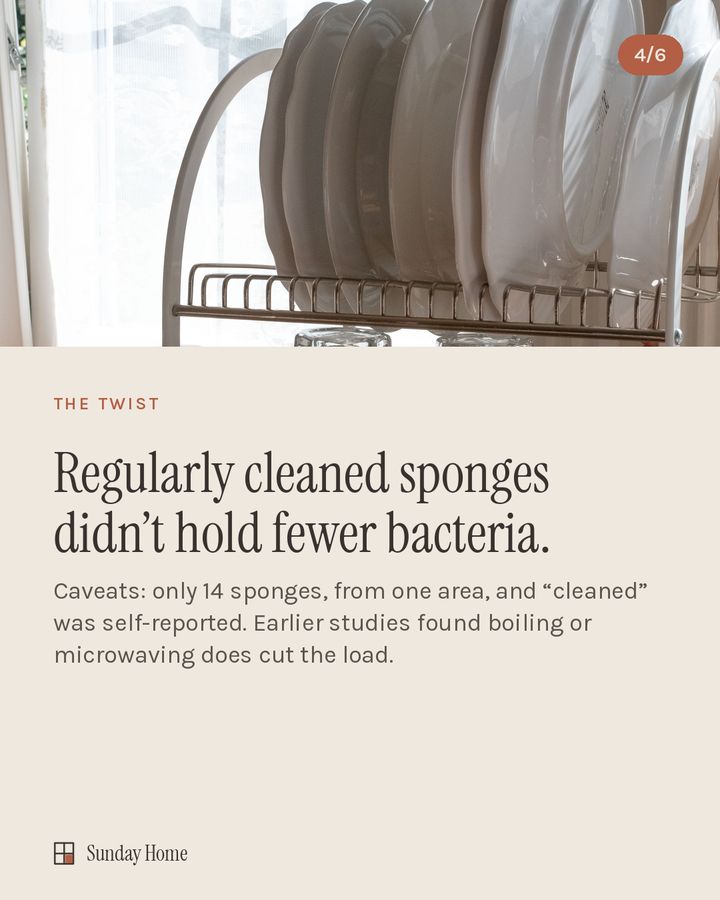
The twist came from asking people how they looked after their sponges. Some said they cleaned theirs regularly, by microwaving them or rinsing them in hot, soapy water. Those sponges didn’t hold fewer bacteria than the uncleaned ones. In the sponges that got “special cleaning,” a couple of bacterial groups actually made up a larger share of what was living there.
Before you throw out the microwave idea, here are three important caveats:
- Fourteen sponges is a very small sample, from one area.
- “Regularly cleaned” was whatever the owners said, not a lab-controlled method.
- The same paper notes that earlier studies found boiling or microwaving does significantly cut a sponge’s bacterial load.
So cleaning isn’t pointless. It just may not reset the sponge the way we picture.
The researchers’ practical suggestion was simple: replace kitchen sponges on a regular schedule, for example weekly. NPR’s food team covered the study at the time, and the food safety expert it interviewed also suggested swapping sponges every week or two.
Sunday Home
Try this at home
Give your sponge an expiration date. Pick a day of the week, say Sunday, and swap in a fresh one. If a weekly swap feels wasteful, move the old sponge to jobs away from food, like the trash can lid or the floor, and keep the new one for dishes.
Be honest: how old is the sponge next to your sink right now?
The carousel — scroll sideways
Sources
Everything above is checked against these. Open any of them.
- Cardinale M. et al., *Scientific Reports*, 2017 (used kitchen sponge microbiome study)https://pmc.ncbi.nlm.nih.gov/articles/PMC5517580/
- Built on: NPR The Salt, “So Your Kitchen Sponge Is A Bacteria Hotbed. Here’s What To Do,” Sept 11, 2017https://text.npr.org/548926054
Next story
 Kitchen