
Picture coming home with five bags of groceries and leaving two of them on the curb. The Natural Resources Defense Council uses that image to explain American food waste, and the numbers behind it are hard to shake.
NRDC’s 2017 report Wasted estimates that 40 percent of the food in the U.S. never gets eaten. That’s more than 400 pounds per person per year, and for a household of four it comes to about $1,800 a year. Citing an industry-wide analysis, the report adds that households, not farms or restaurants, produce the largest share of that waste. (Government estimates put it a little lower: the EPA says about one-third of U.S. food goes uneaten. Either way, it’s a lot.)
One quiet cause is the little printed date.
According to the FDA, a “use by” date is generally the manufacturer’s suggestion for when the food is at its best quality. It is not a food safety date. The FDA says a product may be “wholesome and safe” well past it. The big exception is infant formula, plus some baby foods, which really do need to be used by the date on the package.
That doesn’t mean anything goes. If food looks, smells or feels spoiled, it goes. The FDA also warns that food can make you sick even when it doesn’t look, smell or taste spoiled, so your nose isn’t a safety test. Temperature matters too: the FDA’s guidance is a fridge at or below 40°F and a freezer at 0°F. The door is the warmest part of the fridge, which is why the FDA says eggs belong inside the fridge in their carton, not in the door.
So the date mostly tells you about quality. Safety depends far more on how the food has been stored and handled.
Sunday Home
Try this at home
Two small moves this week:
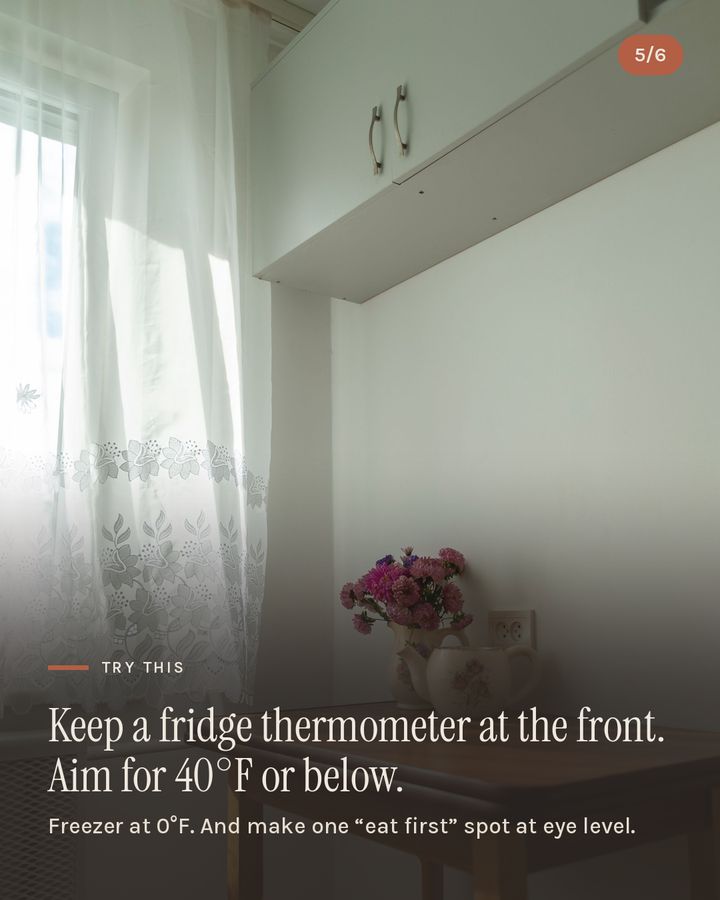
- Put a simple fridge thermometer near the front, where it’s easy to read, and check that it stays at 40°F or below. The dial inside many fridges shows settings, not degrees.
- Make one “eat first” spot at eye level for opened jars, leftovers and anything near its date. Food you can see is food you use.
What’s the one food that always seems to die in your fridge before you get to it?
The carousel — scroll sideways
Sources
Everything above is checked against these. Open any of them.
- NRDC, *Wasted: How America Is Losing Up to 40 Percent of Its Food from Farm to Fork to Landfill*, 2nd ed., 2017https://www.nrdc.org/sites/default/files/wasted-2017-report.pdf
- FDA, “Are You Storing Food Safely?”https://www.fda.gov/consumers/consumer-updates/are-you-storing-food-safely
- EPA, Food Waste Research (“approximately one-third”)https://www.epa.gov/land-research/food-waste-research
- Background (not quoted, 2012 figures not used): NPR Science Friday, “The Ugly Truth About Food Waste in America”https://text.npr.org/161551772
Next story
 Kitchen