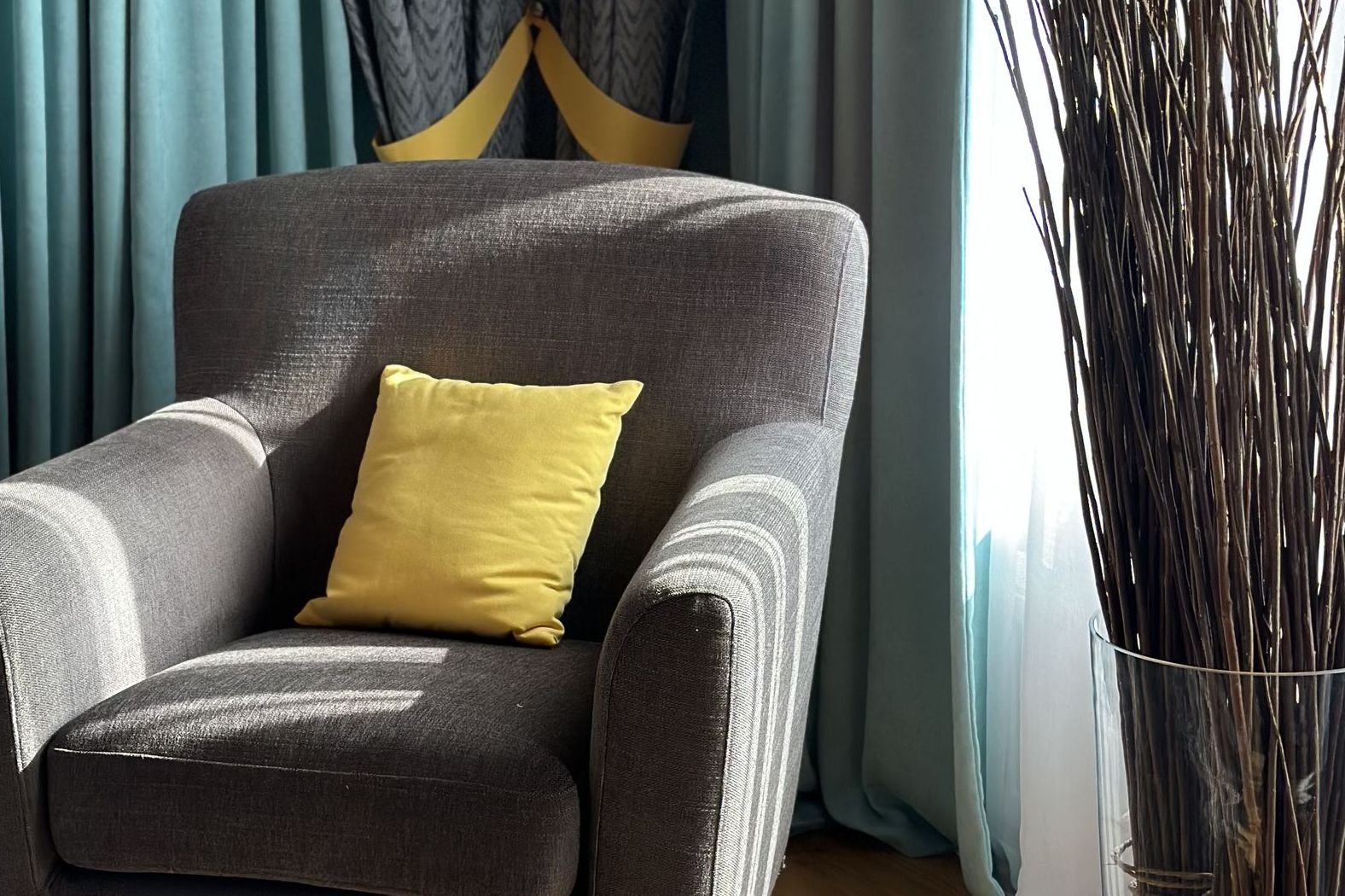
Every sunny living room has one: the sofa arm that’s a shade lighter than the rest, the rug with a pale rectangle where the light hits every afternoon.
Museum conservators think about this problem for a living, and the Canadian Conservation Institute, part of the Government of Canada, lays out the rules in its guidance on textiles. Three of them are worth bringing home.
1. Light damage is permanent. In CCI’s words, “Light damage is cumulative and irreversible.” There’s no cleaning it back. Once a dye has faded or a fiber has weakened, it stays that way.
2. It’s a running total. Conservators measure exposure as light level multiplied by time. CCI’s example: 100 lux for 400 hours does the same damage as 50 lux for 800 hours. Half the light for twice as long is no better. A gently lit room isn’t safe, it’s just slower.
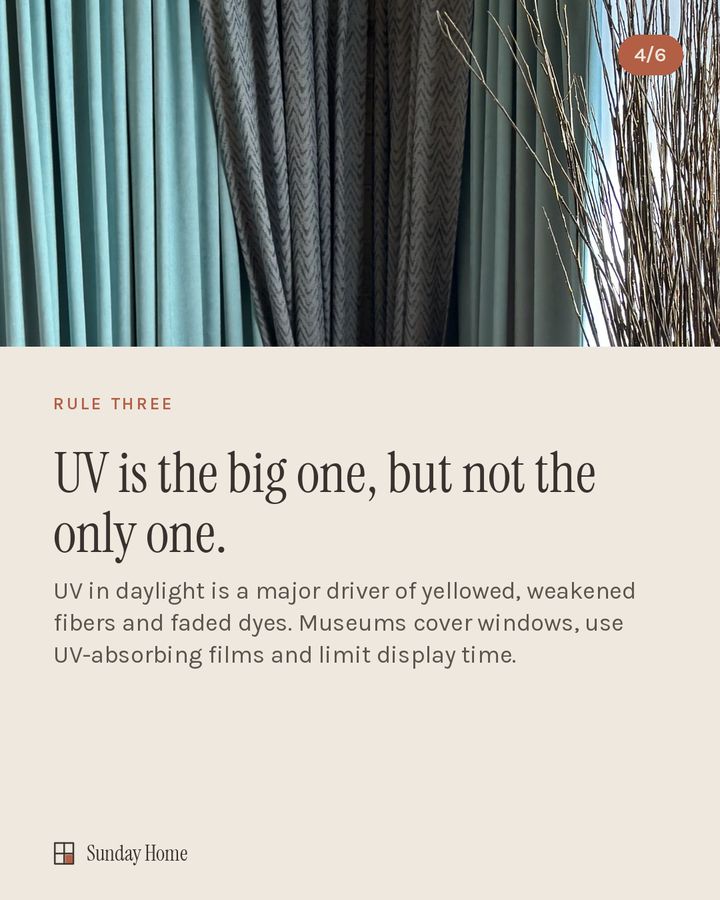
3. UV is the big one, but not the only one. According to CCI, the UV in daylight, sunlight and some electric lights is a major driver of yellowed, weakened fibers, and it fades or changes the color of many dyes, natural and synthetic alike. It also says, more broadly, that light fades colors and weakens fibers.
To protect textiles, museums cover windows in display and storage areas, use UV-absorbing window films, and limit how long a textile stays on display. CCI gives three months as an example maximum.
Your living room isn’t a museum, and it shouldn’t be. You want the sunlight. But the running-total idea is the useful part: every sunny afternoon goes on the tab, and nothing ever comes off.
Sunday Home
Try this at home
Borrow the museum’s playbook, living-room edition:
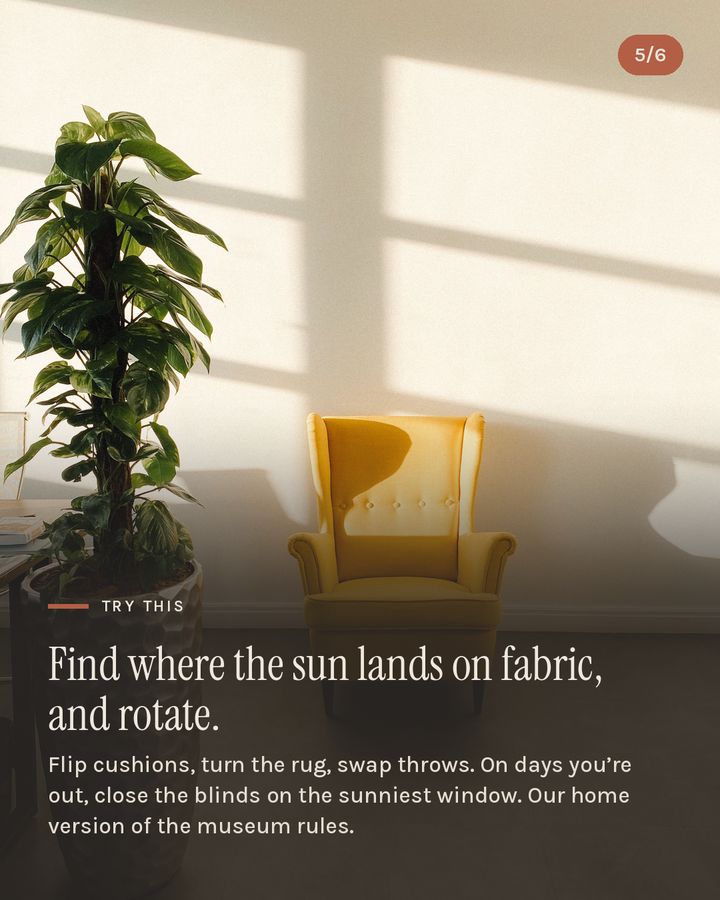
- Find the spot where direct sun lands on fabric: a sofa arm, a cushion, a rug, a throw. Watch for one afternoon.
- Rotate what you can. Flip reversible cushions, turn the rug, swap throws between rooms every season or so, so no one spot takes all the exposure.
- On days you’re out, close the curtains or blinds on the sunniest window. Light that falls on an empty room still counts.
Show us your sun line: what in your home has faded on one side only?
The carousel — scroll sideways
Sources
Everything above is checked against these. Open any of them.
- Canadian Conservation Institute, “Textiles and the Environment,” CCI Notes 13/1 (date modified 2025-07-18; quotes “Light damage is cumulative and irreversible,” 100 lux/400 hours = 50 lux/800 hours, UV causes yellowing, weakening and dye fading, light “fades colours and weakens fibres,” covering windows, UV-absorbing films, three-month display maximum)https://www.canada.ca/en/conservation-institute/services/conservation-preservation-publications/canadian-conservation-institute-notes/textiles-environment.html
Next story
 House Systems