Scientists have known for decades that flushing throws tiny droplets into the air. Nobody had actually watched it happen.
In 2022, engineers at the University of Colorado Boulder set up two green lasers and high-resolution cameras around a toilet and pressed the handle. Their study, published in Scientific Reports, was the first to directly visualize the plume.
The plume shot upward at about 6.6 feet per second, and within 8 seconds it was 4.9 feet above the bowl. Large droplets fell back onto nearby surfaces in a matter of seconds. The tiniest particles, under 5 microns, lingered, some for minutes or longer.
“We had expected these aerosol particles would just sort of float up, but they came out like a rocket,” said lead author John Crimaldi.
Important details: the toilet was a brand-new, clean, lidless commercial model, the kind with a flush valve you see in public restrooms. It held only tap water. No waste, no paper, no germs. It measured how the spray moves, not what’s in it.
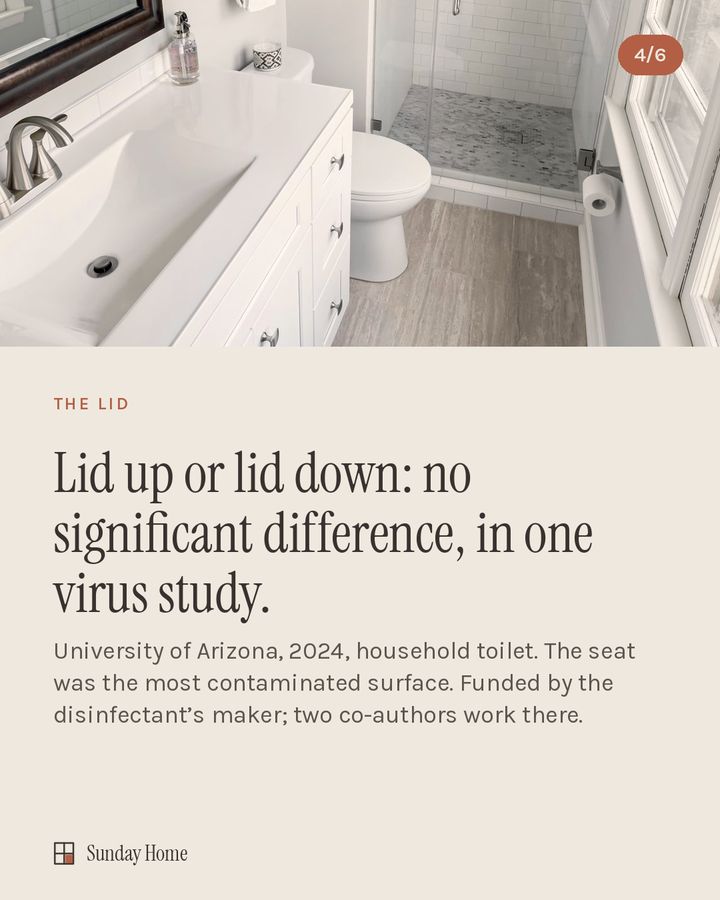
So, should you close the lid? You’d think so. A 2024 study from the University of Arizona, published in the American Journal of Infection Control, tested household and public toilets seeded with a virus that doesn’t infect people. On the household toilet, they found no statistically significant difference in how much virus landed on the toilet and nearby floor, lid up or lid down. The researchers noted that closing the lid may change the direction of the spray. The toilet seat was the most contaminated surface. What did make a big difference was cleaning the bowl with a disinfectant and a brush.
Two things to know about that study. Earlier research had found closing the lid can reduce the spread of bacteria; this one looked at a virus. And it was funded by a grant from Reckitt Benckiser, the company that makes the disinfectant used, with two co-authors who work there. That doesn’t make it wrong, but you should know it.
Sunday Home
Try this at home
Closing the lid is a fine habit, just don’t count on it alone. The seat, the most contaminated surface in the Arizona study, and the floor around the toilet are worth adding to your regular bathroom cleaning, along with the bowl itself. Follow the directions on whatever cleaner you use.
Lid down before you flush: always, never, or starting today?
The carousel — scroll sideways
Sources
Everything above is checked against these. Open any of them.
- CU Boulder Today, “CU scientists shine light on what comes up when you flush” (Dec 8, 2022; 6.6 ft/s, 4.9 ft in 8 s, <5 microns, lidless new clean toilet with tap water, “like a rocket”)https://www.colorado.edu/today/2022/12/08/cu-scientists-shine-light-what-comes-when-you-flush
- Built on: Smithsonian, “Here’s What Really Happens When You Flush a Toilet” (Kuta, 2022)https://www.smithsonianmag.com/smart-news/heres-what-really-happens-when-you-flush-the-toilet-180981278/
- APIC release via EurekAlert, Goforth et al., *AJIC* (lid study; no statistical difference; seat most contaminated; disinfectant + brush; prior bacterial studies; Reckitt funding and co-authors)https://www.eurekalert.org/news-releases/1031976
- CIDRAP summary of the same study (surrogate bacteriophage, funding disclosure)https://www.cidrap.umn.edu/covid-19/closing-toilet-lid-flushing-doesnt-keep-viral-spray-inside-study-suggests
Next story
 Bedroom