Everybody knows the rule. Food on the floor is fine if you grab it fast, because germs need a few seconds to climb aboard.
At Rutgers University, food scientist Donald Schaffner and graduate student Robyn Miranda decided to test it properly. Their study appeared in 2016 in Applied and Environmental Microbiology.
The setup was thorough. Four surfaces: stainless steel, ceramic tile, wood and carpet. Four foods: watermelon, bread, buttered bread and gummy candy. Four contact times: under one second, 5 seconds, 30 seconds and 5 minutes. The bacteria were also prepared two different ways, which made 128 scenarios, and each one was repeated 20 times, for 2,560 measurements. The surfaces were coated with a harmless, food-grade bacterium and allowed to dry before anything was dropped.
Here’s what came back.
Some bacteria transferred in under a second. That alone knocks out the rule. In Schaffner’s words, bacteria “can contaminate instantaneously.”
Wet food is the worst. Watermelon picked up the most bacteria. Gummy candy picked up the least. As Schaffner put it, “Bacteria don’t have legs, they move with the moisture.”
Longer is still worse. In general, more contact time meant more transfer. So the rule isn’t pure fiction. It’s just a big oversimplification.
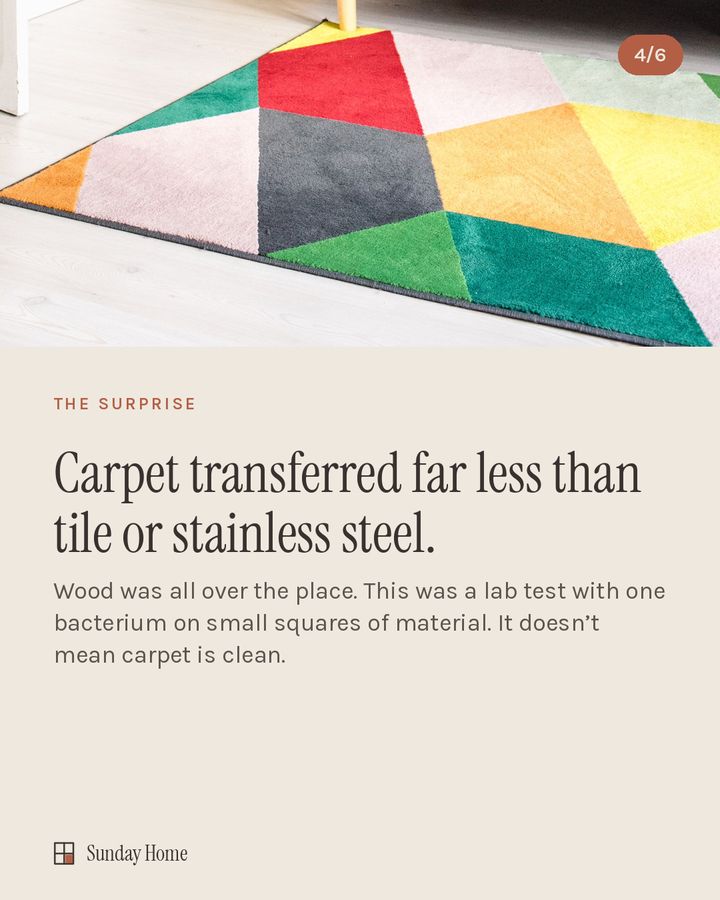
Carpet was the surprise. It transferred far less than tile or stainless steel. Wood was all over the place. The researchers pointed to the texture of the surface and the food as the likely reason.
Keep in mind: this was a lab test with one bacterium on small squares of material. Your floor, and whatever lives on it, is a different story. Carpet transferring less in this test doesn’t mean carpet is clean.
National Geographic was among the outlets that picked up the study at the time. The verdict from the lab itself was blunt: Schaffner called the rule “a significant oversimplification.”
Sunday Home
Try this at home
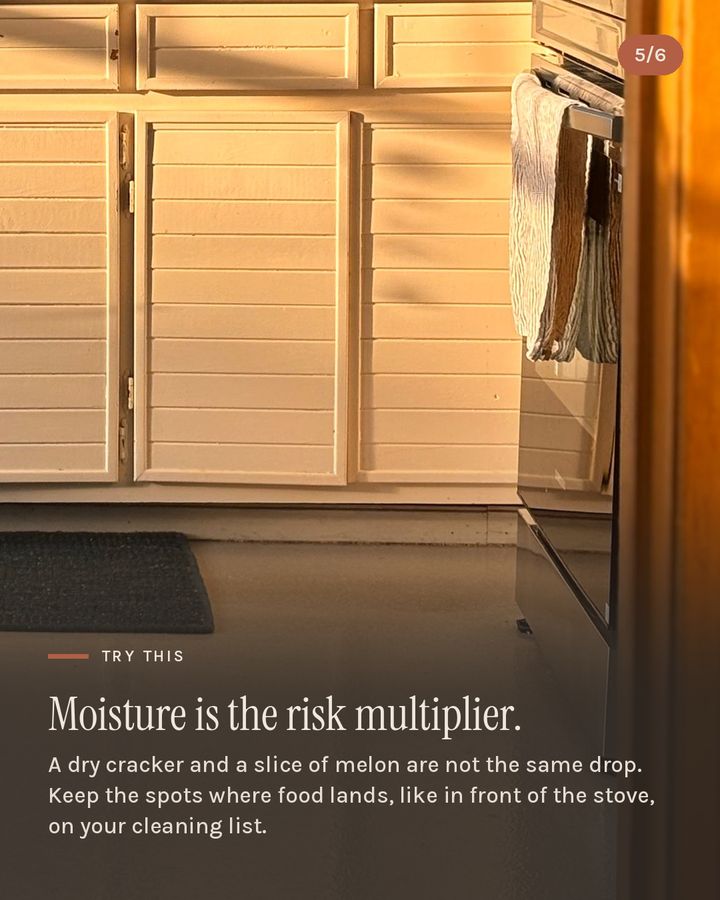
Use the study’s real lesson: moisture is the risk multiplier. A dry cracker and a slice of melon are not the same drop. And since smooth, hard surfaces passed bacteria along more readily, keep the areas where food lands most often, like the floor in front of the stove and under the kids’ chairs, on your regular cleaning list.
What’s your house rule: five seconds, three, or “it depends what it is”?
The carousel — scroll sideways

Sources
Everything above is checked against these. Open any of them.
- Miranda R.C. & Schaffner D.W., “Longer Contact Times Increase Cross-Contamination of Enterobacter aerogenes from Surfaces to Food,” *Applied and Environmental Microbiology*, 2016 (design, 2,560 measurements, nonpathogenic food-grade organism, watermelon most/gummy least)https://pmc.ncbi.nlm.nih.gov/articles/PMC5066366/
- Rutgers University release (quotes, carpet vs. tile and steel, wood variable)https://www.rutgers.edu/news/rutgers-researchers-debunk-five-second-rule-eating-food-floor-isnt-safe
- Built on: National Geographic, “Is the 5-second rule true? Science finally has an answer.” (Engelhaupt, 2016)https://www.nationalgeographic.com/premium/article/five-second-rule-food-safety
Next story
 Kitchen